World Cup returns
to Latin America
Lorena Sánchez García
 After
28 years, football’s World Cup returns to Latin
America, and this time in a big way, since the
Brazil 2014 competition will not only take place in
the international football mecca, but the region
will be well-represented with teams qualifying from
Brazil, Argentina, Uruguay, Colombia, Chile,
Ecuador, Costa Rica, Honduras and Mexico. The
setting, plus the fact that no European team has
ever won a title playing in the Americas, make the
event a real opportunity for countries on this side
of the Atlantic.
After
28 years, football’s World Cup returns to Latin
America, and this time in a big way, since the
Brazil 2014 competition will not only take place in
the international football mecca, but the region
will be well-represented with teams qualifying from
Brazil, Argentina, Uruguay, Colombia, Chile,
Ecuador, Costa Rica, Honduras and Mexico. The
setting, plus the fact that no European team has
ever won a title playing in the Americas, make the
event a real opportunity for countries on this side
of the Atlantic.
Well before the first kick-off takes
place June 12, favorites in the battle were
identified: Spain, as the champion to be dethroned;
Germany with the most talented mid-field in recent
memory; Argentina, with a first class offense;
Uruguay, dreaming of a repeat Maracanazo; plus Italy,
Britain and France, which as past champions, and
traditional powers, draw thousands of fans.

The Beira Rio
Stadium in Porto Alegre will host five World Cup
games, including the quarter finals. The first round
games scheduled there are France vs Honduras;
Australia-Netherlands, South Korea-Algeria and
Nigeria-Argentina.
All of them can, with good reason,
be considered candidates, although other teams could
be added to the list, since they too have stars on
their rosters.
Portugal, with just Cristiano
Ronaldo - if he does ultimately play – meets this
requirement, as well as the always-competitive
Netherlands, with Arjen Robben, Wesley Snaijder and
Robin Van Persie.

Ball control
and a strong defense are Brazil’s strong points,
with the team vying for a sixth title on their home
turf.
Belgium’s Red Devils, despite having
missed the big event for the last 12 years, are
counting on the surprise factor, with a new
generation of largely unknown, excellent players,
including Chelsea half-back Eden Hazard and Thibaut
Courtois, an Atlético de Madrid goalie.
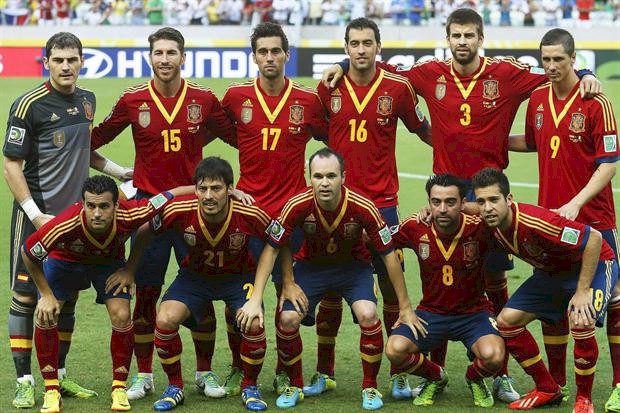
Will the
Spanish led by Vicente del Bosque be able to defend
their title, and debunk the myth that no European
team can win on this side of the Atlantic?
Brazil 2014, much awaited by
football fans everywhere, will no doubt capture the
world’s attention, despite shortcomings which have
emerged on the organizational level. With opening
day just around the corner, International
Association officials have expressed concern about
the readiness of three stadiums, among the 12
scheduled to be used in World Cup competition.
Venues in the cities of Natal, Porto Alegre and Sao
Paulo, have, reportedly, not yet been adequately
tested to ensure functioning during the tournament.
 Brazil’s
former star player Ronaldo Luiz Nazario de Lima
expressed his confidence that the World Cup in
Brazil will be brilliant. Foto: EFE.
Brazil’s
former star player Ronaldo Luiz Nazario de Lima
expressed his confidence that the World Cup in
Brazil will be brilliant. Foto: EFE.
Other problems have emerged over the
last few months, including a petition by the
Brazilian Athletes’ Federation to change the
scheduling of games set to begin at 1:00 pm, arguing
that the heat and humidity at this hour could have a
negative impact on players, especially at sites in
the northern part of the country. If changes are not
made, officials have suggested a two-minute recess
during each period, to allow players to hydrate.
Protests continue denouncing the sky-rocketing
cost of hosting the World Cup, while former player
Ronaldo Luís Nazario de Lima, a member of the
organizing committee, said in an interview with the
daily Folha de Sao Paulo that the World Cup
would be a brilliant event, even though Brazil will
not benefit from its legacy as expected, if the
International federation doesn’t promote another
such event in Brazil.
 Football
fans across the planet are waiting to hear if
Portugal’s FIFA Ballon d’Or winner Cristiano Ronaldo
will overcome injuries and arrive in shape to shine
during the Brazil World Cup.
Football
fans across the planet are waiting to hear if
Portugal’s FIFA Ballon d’Or winner Cristiano Ronaldo
will overcome injuries and arrive in shape to shine
during the Brazil World Cup.
Beyond preferences for one team or
another, the tournament is of interest to fans who
keep track of records. This could be the World Cup
during which Ronaldo’s record as the event’s highest
scorer, (15 goals), could be broken by Germany’s
Miroslav Klose. Italy could match Brazil’s record of
five world titles, and Germany will go down in
history as the first team to play 100 games in World
Cup competition, after debuting against Portugal in
Group G’s first game. (Brazil has 97.)

Sao Paulo’s
beautiful Arenas Corinthians Stadium, with seating
for 61,606, was chosen for the inaugural game,
Brazil-Croatia.
Cuba did not qualify for Brazil
2014, but fans will nevertheless experience the
World Cup’s magic, having adopted several
participants as their favorite. Easy to find are
enthusiastic supporters of Brazil, Argentina, Spain,
Germany and Britain. They will be able to follow the
competition, broadcast live.


