Hong Kong Protests: Why Imperialists
Support ‘Democracy’ Movement
Sara Flounders
….
Although using the name, street tactics and appeal
of the Occupy
Wall Street movement, Occupy
Central has
not made one demand on the banks in Hong Kong. In
contrast, Occupy Wall Street was a movement that
focused the outrage of tens of thousands of youth on
the criminal role of the Wall Street banks,
particularly in extracting from the U.S. government
a trillion-dollar bailout that saved the largest
banks while leaving millions of homes of working
people in foreclosure, along with millions
unemployed. In Hong Kong the role of the banks is
enshrined in law for the next 50 years. How can this
be overlooked? Understanding the special status of
the former British colony of Hong
Kong within China is a key part of understanding who
Occupy Central represents. …..
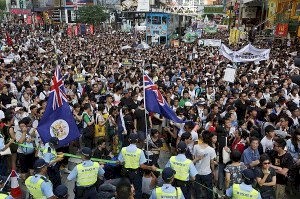 Demonstrations
in Hong Kong, China, raising demands on the
procedures to be followed in city elections in 2017,
have become an international issue and a source of
political confusion. Demonstrations
in Hong Kong, China, raising demands on the
procedures to be followed in city elections in 2017,
have become an international issue and a source of
political confusion.
The protests, called Occupy Central, have received
enormous and very favorable U.S. media coverage.
Every news report describes with great enthusiasm
the occupation of central business parts of Hong
Kong as “pro-democracy” protests. The
demonstrations, which began on Sept. 22, gained
momentum after Hong Kong police used tear gas to
open roads and government buildings.
In evaluating an emerging movement it is important
to look at what political forces are supporting the
movement. What are the demands raised by the
movement, who are they appealing to, and what is the
social composition of those in motion?
The U.S. and British governments have issued
statements of support for the demonstrations.
Secretary of State John Kerry urged Chinese Foreign
Minister Wang Yi to heed the demands of the
protesters. Wang responded by calling for respect
for China’s sovereignty. Britain, which stole Hong
Kong from China in 1842 and held it as a colony for
155 years under a government appointed by London, is
supporting the call for “democracy” in Hong Kong.
Deputy Prime Minister Nick Clegg summoned the
Chinese ambassador in order to convey the British
government’s alarm.
At the present time these imperialists may not
expect to overturn the central role of the Chinese
Communist Party in governing China. But Occupy
Central in Hong Kong is a battering ram, aimed at
weakening the role of the state in the Chinese
economy.
The imperialists hope to embolden the bourgeois
elements and encourage the increasingly strong
capitalist class within China to become more
aggressive and demand the overturn of socialist
norms established after the 1949 socialist
revolution, including the leading role of the
Communist Party in a strong sovereign state.
Police repression: Mexico, Italy, Philippines
In Mexico, tens of thousands of students have been
protesting curriculum changes and new fees. More
than 50,000 demonstrated in Mexico City for the
third time. In western Mexico, 57 students from a
teaching college went missing after gunslingers
fired on a demonstration they were attending,
killing three students and wounding three others. A
Guerrero official says witnesses identified the
shooters as local police officers. Mass graves have
now been uncovered in an area terrorized by police
and gangs.
On Oct. 2, in Naples, Italy, national police
attacked demonstrators protesting against austerity
and a meeting of the European Central Bank. Cops
fired tear gas and water canons at thousands of
protesters.
Thousands of courageous demonstrators in Manila
opposed the signing of an agreement with the U.S.
for an escalating rotation of U.S. troops, ships and
planes into the Philippines during President Obama’s
visit last April. They faced water cannons, tear gas
and mass arrests.
Did any White House officials meet with Mexican
officials to express concern for the killed or
missing students? Did any British officials summon
Italian officials to convey alarm at the tear gas
and water cannons? Was there world media attention
to the attacks on Philippine youth? Where was the
media frenzy? Why is it so dramatically different
regarding Occupy Central in Hong Kong?
The use of tear gas by Hong Kong police is denounced
by the same officials who have been silent as
militarized police in U.S. cities routinely use not
only tear gas but tanks, armored personnel carriers,
live ammunition, electric tasers, rubber bullets,
stun guns, dogs and drones in routine police sweeps.
To hear U.S. officials denouncing restrictions on
candidates in Hong Kong is especially offensive to
anyone familiar with the election procedures in the
U.S. today. Millions of dollars are required to run
a campaign here. Candidates go through multiple
layers of vetting by corporate powers and by the two
pro-imperialist political party apparatuses.
Restrictive ballot measures are in place in every
state and city election.
‘Color revolutions’
Officials and publications in China characterize the
actions of Occupy Central as a U.S.-funded “color
revolution” and compare it to the upheavals that
swept Ukraine and former Soviet republics.
Several commentaries have described in some detail
the extensive role of the U.S. National Endowment
for Democracy and the Democratic National Institute,
along with corporate foundations’ funding of leaders
and the protest movement in Hong Kong.
Thousands of nongovernmental organizations with
large staffs are based in Hong Kong. Their stated
goal is to build democracy. Their real purpose is to
undermine the central role of the Chinese Communist
Party in the organization of Chinese society. Hong
Kong, unlike the rest of China, has allowed these
U.S.-funded NGOs and political associations almost
unlimited access for decades.
Hong
Kong’s special status
Hong Kong’s importance is not due to its size. Its
population of 7.5 million people is half of 1
percent of the population of China. But Hong Kong is
a leading center of finance capital. According to
the 2011 World Economic Forum, Hong Kong had already
overtaken London, New York and Singapore in
financial access, business environment, banking and
financial services, institutional environment,
nonbanking financial services and financial markets.
Hong Kong acts as the financial gateway to China. It
has a guaranteed, banking-friendly, special
administrative status. It is known for its financial
services with insurance, law, accounting and many
hundreds of well-established professional service
firms. Capitalists based in Hong Kong are today the
largest foreign investors in China.
The city of Hong Kong also has the greatest extremes
of wealth and poverty in the world. The city is
famous for glittering skyscrapers and luxury malls
and is home to some of the world’s richest people.
But half live in overcrowded and crumbling public
housing. One-fifth live below the poverty line.
More than 170,000 “working poor” live in cage-like,
subdivided flats. The stacked wire “dog crates” are
6 feet long by 3 feet high and wide, with 30 crates
to a room. The city has no minimum wage.
Occupy?
Although using the name, street tactics and appeal
of the Occupy Wall Street movement, Occupy Central
has not made one demand on the banks in Hong Kong.
In contrast, Occupy Wall Street was a movement that
focused the outrage of tens of thousands of youth on
the criminal role of the Wall Street banks,
particularly in extracting from the U.S. government
a trillion-dollar bailout that saved the largest
banks while leaving millions of homes of working
people in foreclosure, along with millions
unemployed.
In Hong Kong the role of the banks is enshrined in
law for the next 50 years. How can this be
overlooked? Understanding the special status of the
former British colony of Hong Kong within China is a
key part of understanding who Occupy Central
represents.
Colonial status
Hong Kong, as a British colony from 1842 to 1997,
had no elections nor any form of democracy. For 155
years its governors were appointed by Britain.
Hong Kong came into existence as a colony based on a
series of unequal treaties imposed by British
imperialism. Rather than pay in silver, Britain
imposed the sale of opium into China in exchange for
tea, spices, silk and porcelain, valuable trade
items coveted in the West. The growing sale of opium
was resisted by the Qing Dynasty, which confiscated
more than 2 million pounds of opium in 1838.
British armored and steam-powered gunboats, in the
name of “free trade,” opened fire on Chinese cities
on the Pearl and Yangtze rivers, where bamboo, wood
and thatch were common building materials. Cities
and warehouses burst into flames. British forces
seized the island of Hong Kong with its many natural
harbors at the mouth of the vital Pearl River as a
naval base and military staging point for future
wars in China.
The 1842 Treaty of Nanking demanded China pay heavy
indemnities and gave Britain and other foreign
nationals a privileged position of
extraterritoriality in China, along with ceding open
treaty ports and turning over the Island of Hong
Kong. Racist segregation of Chinese people was the
practice in Hong Kong and all the “foreign
concessions.”
In the Second Opium War 15 years later, British,
French, U.S., Japanese and imperial Russian
merchants made further demands, involving gunboats
and thousands of troops. China was forced under
duress to lease additional territory and open more
cities. The demands continued. A 99-year lease for
the islands surrounding Hong Kong, called the “new
Territories,” was signed in 1898. China lapsed into
a period of devastating famines, civil wars and
contending warlords, with underdevelopment and great
poverty for the great majority.
Revolution of 1949
The Chinese Revolution that culminated in 1949,
under the revolutionary leadership of Mao Tse-tung
and the Chinese Communist Party, ended the unequal
treaties and the racist treatment of Chinese people
in their own country and began the reorganization of
the Chinese economy on a socialist basis.
But Hong Kong remained in British imperialist hands;
Macau continued in the hands of old Portuguese
colonialists; and on the island of Taiwan the
defeated, reactionary Kuomintang regime led by
dictator Chiang Kai-shek survived as a U.S.
protectorate. The imperialist countries in the West
and Japan denied technological and industrial
development to the impoverished and underdeveloped
People’s China.
In the 1980s socialist China began opening to
Western capitalist investment on a steadily
expanding basis. The capitalist market in China and
the influence of capitalist property relations have
seriously eroded socialist ownership. But the
centrality of the Communist Party in politics and
the economy has not been broken.
Just as the imperialists 100 and 200 years ago
sabotaged any restraint on their economic
domination, today Wall Street continues scheming to
regain unimpeded access to all of China’s markets.
HKSAR: Special Administrative Region of China
In 1997, the 99-year British lease was scheduled to
end on the British colony of Hong Kong. In 1984,
China signed an agreement with Britain on the future
status of Hong Kong. It was called the Hong Kong
Basic Law.
In order to avoid instability and closing of the
foreign investment flowing through Hong Kong, the
Chinese government, while insisting on the return of
Hong Kong to Chinese sovereignty, agreed to
guarantee capitalist relations there for 50 years
under an agreement called “One Country, Two
Systems,” an idea originally proposed by Communist
Party General Secretary Deng Xiaoping.
Hong Kong became the Hong Kong Special
Administrative Region of the People’s Republic of
China. In the agreement with British imperialism,
the HKSAR would retain the status of an
international financial center with free flow of
capital. The Hong Kong dollar remained freely
convertible.
The status of property rights, contracts, ownership
of enterprises, rights of inheritance and foreign
investment was all guaranteed. The agreement
stipulated that Hong Kong’s capitalist system itself
and its “way of life” would remain unchanged until
2047. A network of private schools, universities and
the large corporate media did not change hands. The
Hong Kong Basic Law further stated that the
socialist system and socialist policies would not be
practiced in HKSAR.
Hong Kong bankers, financiers and industrialists
were assured autonomy, except in foreign and defense
affairs, where the People’s Republic of China would
have full say. It is this minimal control that
Occupy Central is now challenging with the demand
that Chief Executive Cy Leung must resign.
An antiquated judiciary based on British Common Law
upholds the laws that defend the harshest private
property relations. Small claims courts, landlord
courts, labor courts, juvenile courts, coroner’s
courts and courts of appeals all enforce old
capitalist laws, not the laws in place for the 99.5
percent living in the rest of China.
Hong Kong judges still wear British-style outfits,
including wigs made of horsehair, with white gloves,
girdles and scarlet robes added for official
ceremonies.
The guarantee of unrestricted capitalism in Hong
Kong for 50 years means that some of the starkest
extremes of wealth and poverty exist side by side.
U.S.
funded NGOs
Fearful of democratic change coming from the working
class as soon as the British signed the agreement in
1984, the ruling class began to violate it, putting
in place new political parties and organizations to
operate after the return of the territory to China.
After 145 years of appointed government, they
pompously called for democratic change.
Three years before the 1997 handover of sovereignty,
the British changed the constitution and set up
district boards, urban and regional councils, and a
legislative council. These top-down reforms were
strongly opposed by the Chinese government as a
violation of the agreement and a tactic to subvert
its political system.
But more insidious than the official changes was the
vast expansion of U.S. “soft power” in Hong Kong.
Today more than 30,000 NGOs are registered in Hong
Kong. They cover every aspect of life. (Social
Indicators of Hong Kong)
The U.S. funds NGOs for political subversion through
the U.S. State Department’s U.S. Agency for
International Development, which makes grants to the
National Endowment for Democracy (NED), National
Democratic Institute (NDI), National Republican
Institute, Ford Foundation, Carter Center, Asia
Foundation, Freedom House, Soros’s Open Society and
Human Rights Watch, among others.
All these groups and many more fund projects that
claim to be supporting and promoting human rights,
democracy, a free press and electoral reform. This
funding of social networks operates for the same
purposes in Latin America and the Caribbean,
throughout the Middle East and Africa, and in
Eastern Europe and the former Soviet republics.
U.S. imperialism has not established democracy in
any of its hundreds of interventions, wars, drone
attacks, coups or global surveillance. But
“promoting democracy” has become a cover for attacks
on the sovereignty of countries all around the
world.
Of course, religious groups and other states,
especially those in the European Union, also fund
political associations and social networks in Hong
Kong and everywhere across the globe. A few of these
groups may genuinely operate independently and
provide aid to immigrant workers, help low-paid
workers organize, or address housing and health
needs of the most unrepresented in Hong Kong. But
for the most part, the NGOs are a network of “civil
society” organizations controlled by and for U.S.
corporate power.
A
growing number of articles in the Chinese press have
connected the dots of the leaders of Occupy Central
and the U.S.-funded NGOs.
According to China.org.cn, “Each
and every ‘Occupy Central’ leader is either directly
linked to the U.S. State Department, NED, and NDI,
or involved in one of NDI’s many schemes.” (Oct. 6)
Occupy Central’s self-proclaimed leader, Benny Tai,
is a law professor who has received NDI and NED
grants and was on the board of the NDI-funded Center
for Comparative and Public Law. He attended many NDI-funded
conferences. This is also true for another prominent
Occupy Central figure, Audrey Eu.
Also, according to China.org.cn, “Martin
Lee, founding chairman of Hong Kong’s Democrat
Party, is another prominent figure who has come out
in support of Occupy Central. Just this year, Lee
was in Washington meeting directly with Vice
President Joseph Biden and Rep. Nancy Pelosi and
even took part in an NED talk hosted specifically
for him and his agenda of “democracy” in Hong Kong.
Lee even has a NED page dedicated to him after he
was awarded NED’s Democracy Award in 1997. With him
in Washington was Anson Chan, another prominent
figure currently supporting the ongoing unrest in
Hong Kong’s streets.”
A
number of publications in the West are picking up on
these exposés, including Counterpunch in “Hong Kong
and the Democracy Question”; Global Research in
“U.S. Now Admits It Is Funding Occupy Central in
Hong Kong”; and InfoWars.com in “Is the U.S.
Secretly Egging on Hong Kong Protesters?”
Even a Hong Kong poll showed that most of those
making $10,000 a year or less opposed the protests,
while support was highest among people making
$100,000 a year or more.
Wall Street is not satisfied with the deep inroads
that capitalism has made into China and is
increasingly fearful of Chinese competition in
global markets. The U.S. pressure for political
liberalization in China is to promote further
economic opening and further privatization of state
industries.
U.S. and British imperialism hope to use Hong Kong
as they did 150 years ago as a stronghold for
pushing deeper politically into China. Today,
however, they are not facing a backward feudal
dynasty.
As U.S. corporate dominance in production and
finance slips, the Asia pivot of the Obama
administration means that the U.S. ruling class and
its military apparatus has made the decision to
become more confrontational toward Russia and China.
Opponents of U.S. wars and organizations defending
workers’ interests in the U.S. can play an important
role by refusing to align with U.S. schemes aimed at
overturning pro-socialist norms inside China and
undermining Chinese sovereignty.
(Taken from Global Research)
|


