Marlon Brando
loved Havana's nightlife
Rafael Lam
Marlon Brando's visit to Havana in
February, 1956, became a legend, in the world of
celebrity-watching. The actors knowledge of the city
and its attractions was surprising, a bit of a
mystery to some.
|
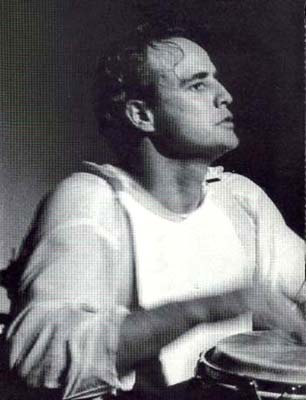
Marlon Brando
plays a tumbadora. |
In fact, since 1952 he had been a
regular at the Palladium, where he took dance
classes and enjoyed the performances of Cubans Mario
Bauzá, Machito and Los Afrocubanos.
The actor enrolled in courses
offered by Catherine Dunham, who taught conga,
rumba, cha-cha-cha, mambo and other dances from
Playa de Marianao cabarets in Havana.
The New York Times had published a
story by Drew Pearson who wrote that any one who
visited the city, and did not go to see Chori in
Playa de Marianao, had not really seen Havana.
While Brando was studying at the
Actor's Studio, he discovered Cuban drumming in
Manhattan. "Every Wednesday night there was a mambo
contest at the Palladium," he said in Songs My
Mother Taught Me, "and I waited for it all week.
Tito Puente, Willie Bobo, Tito Rodríguez, Machito
and the best Afro-Cuban bands played there. After I
started going to the Palladium, I abandoned the drum
set and bought myself some congas. I couldn't stay
still when I heard those extraordinary, syncopated
rhythms. I was hypnotized by all of that, and every
time I had to choose between dancing and drumming, I
chose to drum."
The congas unnerved Brando, "The
discovery of Cuban music was almost made me lose my
head," Brando said in the aforementioned book.
In 1956, the actor was in Miami on
business and decided to travel to Havana. He
registered as Mr. Barker at the Hotel Packard -
which is currently being reconstructed at the corner
of Cárcel and Prado, overlooking the entrance to the
bay. He chose the modest hotel in hopes of spending
a few days here incognito, according to Leonardo
Depestre Catony.
Journalists who always had their
radar functioning found Brando in the hotel lobby,
carrying a tumbadora. He told Carteles
magazine that the drum was
"The real thing, 90 pesos, authentic.
I have six other congas like this one, I just love
them."
A Carteles photographer was snapping
shots of Brando who asked him what magazine the
photos were for, saying that if they were for a U.S.
magazine, he didn't want to be pictured playing the
conga, since it would be interpreted negatively, "For
you, it's natural, part of your lives. Over there it
will be seen as an eccentricity on the part of
another exhibitionist."
Brando toured the city, visiting the
Panchín, Pennsylvania, Pompilio, Ranchito, Taberna
de Pedro, Tres Hermanos clubs and, of course, La
Choricera. Some say he was in the Las Vegas and Sans
Soucí, as well.
Chori, always very careful about who
he let come up onto the stage, begrudgingly allowed
Brando to do so and, much to his surprise, the actor
showed that he was a pretty good drummer.
Brando's first trip to Havana lasted
just three intense nights, after which he returned
to the U.S. with a wicked hang-over, a couple drums
and a great desire to repeat the adventure.
Before leaving, he was interviewed
by Carteles, and said he had come to Cuba because of
the music, to hear it live and that he would return
to Havana because the city moved him, that he
especially loved Havana at night, saying, "The sea
is very strange. It's like the sky. You can see the
things you want to imagine..."


