|
Children enjoy Cuba's National Aquarium
Lisanka González Suárez
Photos: Anabel Díaz Mena
While counting the steps up to the entrance of the
National Aquarium, I mentally reviewed some news I
had read earlier that morning, which had an impact:
A camp in
Northern Siria set up to train child suicide bombers…
Students stabbed in U.S school. Just when I
begin to reflect on the causes of these tragedies, a
busload of school children stopped in front of me
and, like a whirlwind, they descended, heading
straight toward the seals. They were so excited to
see the huge mammals, which seemed to be waiting
just for them. As I arrived, one of the smallest
children was being ‘kissed’ on the cheek by one,
while another waved its fin, to say hello.
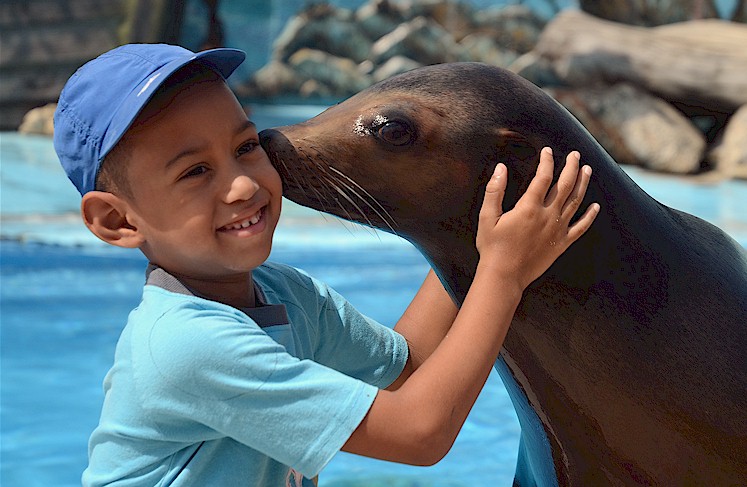
Both looking happy, a child and seal
share affection.
The touching scene made me think again about the
articles I read. I couldn’t help but compare the
situation of Cuban school children with that of
those in other nations, who are deprived of the joy
of childhood; who don’t have the opportunity to go
to school; who work like adults, are prostituted or
fight in wars; or those who, despite living in
developed countries and having a good standard of
living, lack basic security. This is a very real
problem for parents, including many Cuban parents
living abroad. Some opt to send their children to
spend holidays with the relatives they left behind,
on this small, underdeveloped island, where children
go to the aquarium by themselves and play safely in
parks near their homes.
Although the National Aquarium has been open for
more 50 years, its director for the last 24,
Guillermo García Montero, has – in one way or
another – been linked to it since its creation. He
recalled that the idea for a National Aquarium was
proposed in the first months after the triumph of
the Revolution, with construction beginning in June,
1959. A team of six or seven employees working on
the project created experimental laboratories and
began to establish connections with other aquariums
around the world, and foreign companies to purchase
the necessary construction materials. On January 23,
1960, the small aquarium located in the Miramar
neighborhood of Havana, with its staff of 30 and
some 1,500 exemplars of 100 species of marine life,
opened its doors as a scientific, recreational and
educational center.
“At that time, it was the first of its kind to be
built in Latin America and one of the first in the
world,” stated Montero, “There were two or three in
Europe. In Japan and the United States there were
more.”
PERSEVERANCE
Since then the aquarium has seen good times and bad,
despite having faced multiple problems and a
scarcity of materials. During the Special Period of
the 1990’s, a very difficult time for all, they
persevered. Nature however, presented a different
set of problems, hurricanes that pass through or
near the capital have caused considerable damage to
the facilities, some of which has been repaired. The
greatest shame is that these incidents have delayed
the aquarium’s plans.
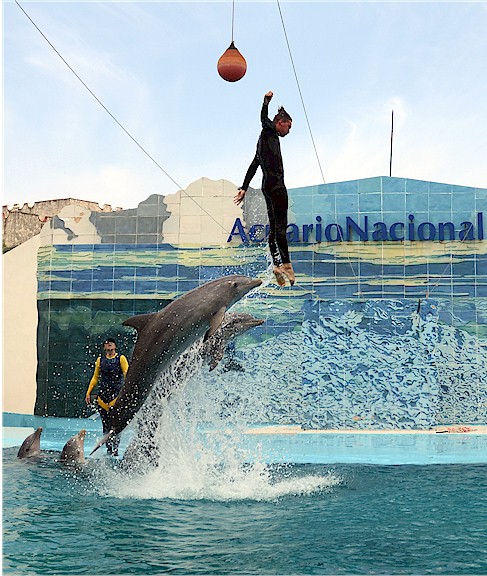
One of the most popular routines in
the dolphin show, with a young trainer who has only
been performing a few days.
The first stage of a renovation project was
completed in 2000, with a new entrance. Two years
later, the second stage was completed with the
inauguration of new pools, fish tanks, and the
opening of various spaces. The work currently being
done is focused on expanding the biodiversity
center, building a new cafeteria with a 400 person
capacity, and an environmental education center.
There is still much more to be done.
Despite the ongoing construction, the aquarium
receives 550,000 visitors annually, a number which
has remained stable for the last 15 years, with
occasional spikes in attendance of up to 750,000, as
when new areas were inaugurated.
Today several generations of trainers, specialists
and workers in general face other challenges to
complete the remaining renovations, making it
difficult to estimate a completion date for the
entire project.
“I can’t tell you that today,” stated Montero, when
I put the question to him.
“The third stage – a new aquarium - is still to be
completed, would be my response.”
Biologists, trainers, maintenance, gastronomy and
service personnel - everyone - is working
efficiently and rigorously, to meet new challenges
coming their way. “Currently, there are only
aquariums in Brazil, Mexico, Venezuela (fresh water)
and Argentina. There are none as large as this one
in Latin America, and I believe that given the
dolphin and sea lion shows, as well as the exhibits
we organize, our aquarium can be considered one of
the best in Latin America, regardless of the fact
that we are currently renovating all the facilities,
which could take one or two more years,” Montero
commented.
Surrounded by the sea
The aquarium is a global pioneer in the creation of
educational programs, which it develops with its own
resources. One example of these are the children’s
science days, which began in 1994 with children from
all over the country participating. By chance, the
19th event was taking place during our visit, with
624 children, 274 from 11 provinces and 20
municipalities throughout the island, and the rest
from the capital.
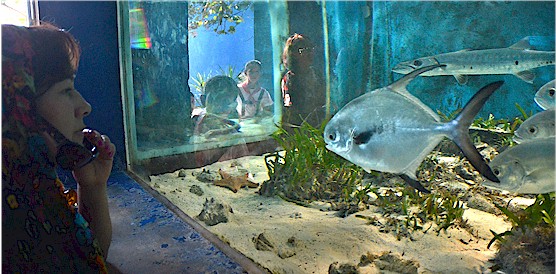
The Children, from nursery, primary and secondary
schools, specialist art and sports institutions and
high schools produced hundreds of works. They
created drawings, posters, stories, educational
games and ceramics; held discussions, sang songs,
performed dances and multimedia presentations, about
the environment and their community, many of which
exceeded expectations, thanks to children’s creative
imaginations.
Montero
emphasized that all activities are funded
exclusively by the National Aquarium, completely
self-sufficient since 1997, receiving financing
solely for construction. The Aquarium maintains
strong ties with international organizations such as
UNESCO, which has supported many of its
environmental education activities, research and
other projects, but has no involvement in daily
operations or investment. Cuban nationals pay an
almost symbolic, low price to see the high quality
sea life shows. This generates revenue of
approximately 8.5 to 9 million pesos annually, plus
funds from international visitors, who pay a higher
admission.
The National Aquarium is the most important one on
the island and despite not having completed the
scheduled renovations; it is visited daily by scores
of children, clapping and enjoying the pirouetting
dolphins and seals, showing their appreciation for
the work of almost 300 personnel who make these
magical shows possible.
|


