|
CELAC repudiates illegal use of
telecommunications against Cuba
The
Community of Latin American and Caribbean States (CELAC)
on April 29 condemned the illegal use of new
information and telecommunications technology
against its member countries, in the wake of recent
revelations about the so-called Cuban Twitter,
ZunZuneo.
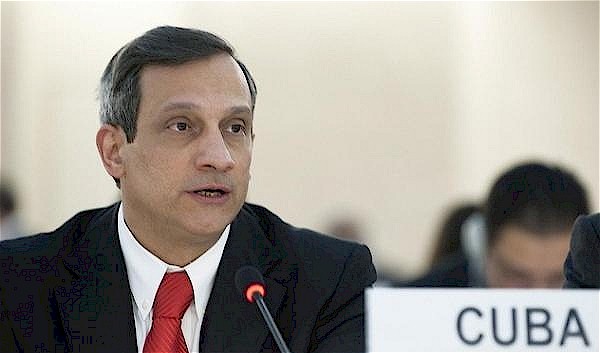
Rodolfo Reyes, Cuban ambassador to
the UN, denounced the Zunzuneo
operation, while also condemning illegal radio and
television broadcasts used
by the United States to promote subversion in Cuba.
The
mobile phone network was established by the United
States Agency for International Development (USAID)
to promote destabilization of Cuba’s internal order,
by sending massive, unsolicited text messages with
subversive content.
The
CELAC statement, released in Havana, asserted that
the use of information and telecommunications
technology, in violation of international
regulations, has a negative impact on nations and
their citizens, emphasizing that all such activity
must be fully compatible with the principles and
purpose of the United Nations Charter and
international law, including respect for national
sovereignty and non-interference in internal
affairs.
The
organization reiterated its desire to cooperate in
the protection of cyberspace, and the promotion of
its use for peaceful ends, insisting that the best
way to combat violations, such as ZunZuneo type
undercover operations, is to cooperate
internationally on regulation. Costa Rica, currently
holding CELAC’s pro tempore presidency, has asked
U.S. authorities to explain illegal acts committed
within Costa Rican national territory, during the
establishment the mobile phone network.
Cuba
denounces ZunZuneo and other subversive efforts at
United Nations
Cuba
also denounced the ZunZuneo operation before the
United Nations, while additionally condemning
ongoing, illegal radio and television broadcasts,
used to implement U.S. policy directed toward
promoting destabilization and ‘regime change’ in
Cuba.
Cuba’s ambassador to the UN, Rodolfo Reyes,
emphasized during the Information Committee’s 36th
period of sessions that the United States has not
abandoned efforts to subvert the political, social
and economic order chosen by the Cuban people
exercising the right to self-determination.
Recently revealed were details of the millions of
dollars spent on the ZunZuneo undercover operation,
a mobile phone messaging network, Reyes reported
during the meeting. Reyes explained that the illegal
network was active from 2009 through 2012, and was
used to collect users’ personal information, without
their permission. This data was then used to create
profiles and lists based on gender, age, interests
and affiliations of different kinds, meant to be
utilized for subversive purposes.
U.S.
media have released information revealing the scope
and magnitude of ZunZuneo, which was created with
financing from the U.S. Agency for International
Development (USAID). This and other destabilization
operations violate both Cuban and U.S. laws,
including the CAN-SPAM Act, approved by Congress in
2003, which prohibits the sending of unsolicited
commercial text messages, Reyes commented.
He
added that such activities violate the International
Telecommunications Union’s (ITU) constitution, using
advanced technology - social networks in particular
– for purposes far removed from the promotion of
peaceful relations and international cooperation. In
regards to radio and television broadcasts, Reyes
decried the fact that, more than a year since his
last presentation to the UN General Assembly’s
Information Committee, 1,909 to 2,070 broadcast
hours of subversive content are directed toward Cuba
every week, using more than 27 different
frequencies, in flagrant violation of ITU
regulations. The Cuban diplomat emphasized that the
recently revealed U.S. destabilization projects are
“just one page in the more than 50 year history of a
hostile policy toward Cuba, which is now supported
with new information technology and
telecommunications.”
Cuba, through its permanent representative in the
UN, has demanded that the United States respect
international law and end such illegal projects,
meant to compliment the economic, commercial and
financial blockade it has imposed on Cuba, since
shortly after the triumph of the Revolution on
January 1, 1959.
Reyes furthermore emphasized that U.S. actions
confirm the need to establish a new mode of
governance for internet use and telecommunications,
a new, more just and effective framework directed
toward promoting peace and international
understanding. (PL)
|


