|
University of Medical Sciences
Professional training directed toward
meeting the country’s needs
• Cuba prepares to modify eight
health technology courses of study, which some 3000
students are currently pursuing
Lisandra Fariñas Acosta
Photo:
Jorge Luis González
How
to provide quality training for healthcare
professionals, which responds to the needs of the
population and the country, was one of the principal
topics discussed by participants of the II
International Health and Technology Conference.
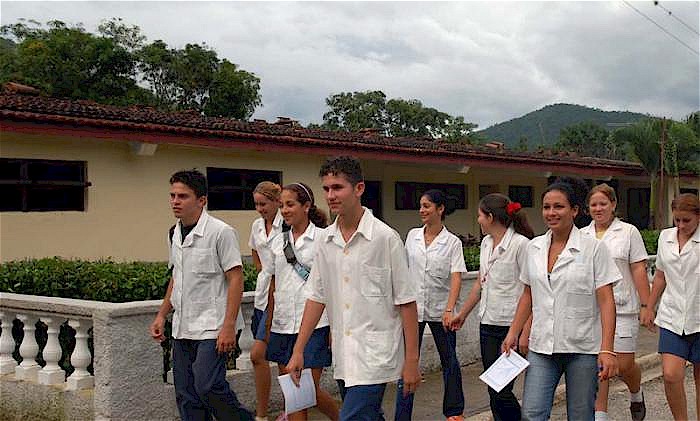
Some 3,000 students are currently
pursuing Medical Technology degrees.
Acquiring adequate training is one of the daily
challenges that professionals face, especially when
teaching young students about illnesses which don’t
generally affect the Cuban population, but do exist
in other parts of the world, explained Dr. Jorge
González Pérez, rector of the University of Medical
Sciences, to Granma. He also pointed out that
despite the difficulty, this has been achieved and
is evidenced by the impact of Cuban health workers
serving abroad.
Talking about the challenges the system faces in
dealing with an aging population, Dr. Pérez pointed
out that health and human resource training is well
structured and geared towards prevention.
Reaching old age is indicative of Cuba’s quality of
life and the population’s good health. However, when
there are a large number of elderly people requiring
differentiated and personalized care, it creates an
overload. “We are talking about a population which
will have lower birth rates and at the same time
become less productive”.
The
demand for services such as physiotherapy and
rehabilitation has increased. Now the majority of
patients go to rehabilitation centers but there will
come a time when we will have to visit patients at
home. In this sense – he commented – Cuba has
advantages in the primary care system, with
Community Clinic doctors, nurses and basic equipment
which will play a central role.
The
University of Medical Sciences is preparing to
tackle all these issues, focusing especially on the
eight most popular specializations of Health
Technology, in which some 3,000 students are
involved.
Addressing the significance of new technology in
training future technicians, Dr. Pérez emphasized
the university’s desire to provide training software
for every course, which the students could use for
independent study. “Now all medicine - and some
dentistry - courses are completely digitalized.
However, for the moment, Technology degrees are not,
but new course plans are currently being
constructed”.
Dr.
Pérez stressed that the University is in line with
global trends in higher education. “Our University
prioritizes specialized, horizontal training, in
real life situations and assisted by experienced
tutors. We promote the value of education in
students and teachers as facilitators of learning;
that is why we must prioritize training for those
who will become future teachers.
|





