|
CELAC has been built upon
a legacy of
two hundred years of struggle for independence
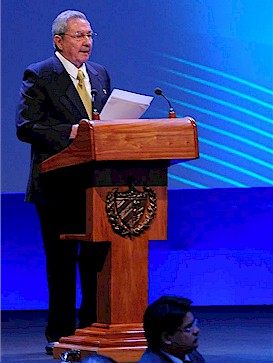
• Remarks by Army General Raul Castro
Ruz, President of the Councils of State and
Ministers of the Republic of Cuba opening the
Community of Latin American and Caribbean States
Summit, January 28, 2014
Esteemed Heads of State and Government of Latin
America and the Caribbean;
Distinguished Foreign Ministers and guests;
 On
behalf of the people and the government of Cuba I
warmly welcome you and wish you a pleasant stay. It
is for us a great honor and a reason for sincere
gratitude to be able to count on your presence in
this Summit of “Our America,” which has been
convened on the occasion of the one hundred and
sixty first anniversary of the birth of José Martí. On
behalf of the people and the government of Cuba I
warmly welcome you and wish you a pleasant stay. It
is for us a great honor and a reason for sincere
gratitude to be able to count on your presence in
this Summit of “Our America,” which has been
convened on the occasion of the one hundred and
sixty first anniversary of the birth of José Martí.
We
deeply regret the physical absence of one of the
great leaders of Our America, the unforgettable
Venezuelan President Hugo Rafael Chávez Frías, who
fervently and tirelessly advocated and struggled for
the independence, cooperation, solidarity,
integration and unity of Latin America and the
Caribbean and for the creation of this very
Community.
I
would like to propose a one-minute moment of silence
in his memory.
Distinguished colleagues:
The
period elapsed since the celebration of the last
CELAC Summit has been complex but fruitful.
The
Latin American and Caribbean countries have been
required to face a number of challenges. The crisis
has continued to affect the world's economy; the
dangers which threaten peace are ever more present
in several regions of the world; and some sister
nations have been subjected to threats, unilateral
coercive measures and international lawsuits due to
legitimate actions they have taken to defend their
sovereignty.
We
have, however, been able to make further progress in
the construction of CELAC and follow up on decisions
adopted in Caracas and Santiago de Chile.
Step
by step, we are creating a Community of Latin
American and Caribbean States that is currently
recognized in the world as the legitimate
representative of the interests of Latin America and
the Caribbean.
Likewise, we have been reconciling our views and,
despite the inevitable differences, a spirit of
greater unity within diversity is being developed,
and that should be our ultimate goal.
As I
said in Santiago de Chile, “We know that, among us,
distinct ideas and even differences exist, but CELAC
has been built upon a legacy of two hundred years of
struggle for independence and is based on a profound
commonality of goals. Therefore, CELAC is not a
succession of mere meetings or pragmatic agreements,
but a common vision of a Greater Latin American and
Caribbean Homeland which solely has a duty to its
peoples.”
One
of our priorities should be the creation of a common
political space in which we can move forward toward
the achievement of peace and respect among our
nations; in which we are able to overcome the
objective obstacles and those deliberately imposed
upon us; in which we can utilize our resources in a
sovereign way and for our common wellbeing and place
our scientific and technical knowledge in the
service of progress for our peoples; in which we can
assert undeniable principles such as
self-determination, sovereignty and the sovereign
equality of States.
Only
in this way can we ensure that the assertion
describing Latin America and the Caribbean as the
most unequal region in the planet no longer be a
reality.
Cuba's Pro Tempore presidency of CELAC has focused
precisely on the achievement of this goal. That is
why the central theme of this Summit is the struggle
against poverty, hunger and inequality.
While it is true that some progress has been made
during the last few years, it has been slow,
fragmented and unstable. According to ECLAC - to
which we convey our appreciation for its consistent
cooperation with the Cuban presidency and the five
studies it carried out in the context of this
cooperation - the poverty rate in Latin America and
the Caribbean in 2012 reached, as a minimum, 28.2%
of the population; that is to say, 164 million
people. And the abject or extreme poverty rate was
11.3%, equivalent to 66 million inhabitants in the
region. The most distressing concern, however, is
child poverty, which affects 70.5 million boys,
girls and adolescents; 23.3 million of whom live
below the poverty line.
The
richest 10% in Latin American receive 32% of the
total income, while the poorest 40% receive only
15%.
The
peoples of Latin America and the Caribbean demand
and require a better distribution of wealth and
income, universal and free access to quality
education, full employment, higher salaries, the
eradication of illiteracy, the establishment of true
food security, health systems for all, the right to
decent housing, fresh water and sanitation services.
These are all achievable goals, progress toward
which will be indicative of progress in our region.
We
are in a position to reverse the current situation.
With slightly more than 15% of the earth's surface
and 8.5% of the world's population, our region
possesses a substantial percentage of the most
important non-renewable mineral reserves; one third
of the fresh water reserves; 12% of the arable land;
the world's greatest potential for food production
and 21% of natural forests.
And
it is precisely all this wealth which should become
the driving force in eradicating inequalities. The
imperative and challenge we face is being capable of
transforming this natural capital into human
capital, into economic infrastructure and
diversification of production and exports, in a way
that decisively contributes to a true development
process.
One
of the problems we face in Latin America and the
Caribbean is the inability to translate the periods
of high prices of the natural resources we export
into long-term economic development processes, in
such a way that they could truly contribute to the
reduction of poverty and increase the per capita
income of our populations. To do so we should fully
exercise sovereignty over our natural resources and
design appropriate policies to guide our relations
with foreign investors and transnational companies
operating in CELAC member countries.
The
benefits of direct foreign investments for the
economies of the region and the injection of capital
by the transnational companies operating here are
undeniable, but we forget that the excessive growth
in profits obtained - 5.5 times as much over the
last nine years - affects the positive impact of
such benefits on the balance of payments of our
countries.
When
it comes to education, the region faces significant
needs, both in terms of access as well as in terms
of quality; functional illiteracy continues to exist
- although with significant differences from one
country to another.
While access to primary education has improved in
the region, information gathered by ECLAC and UNESCO
establishes very clearly that access to education,
and the quality of training which students receive,
are very much linked to income levels.
The
situation is far more serious in secondary
education, not only because 50% of youth between the
ages of 20 and 24 dropped out, but because only
21.7% of youth from the poorest sector in that age
group were able to finish school. In contrast,
78.3% of their peers in the richest sector managed
to complete this level of education. That is to
say, a 56.6 percentage point gap separated the two
groups in 2010.
In
the case of university education, the situation is
even more complex. According to some estimates
issued by ECLAC, in the year 2010 enrollment at this
level accounted for one third of youth between the
ages of 18 and 24.
We
have all the means, resources and methodologies
necessary to eradicate illiteracy across Latin
America and the Caribbean. We should demonstrate
the political will to do so and give our peoples,
without exceptions or inequalities, the opportunity
to access all educational levels.
None
of the projects which we intend to pursue will be
possible without educated and cultured peoples.
The
different levels of development among the social and
productive sectors in our countries present an
opportunity for cooperation, for complementarity and
integration of our economies, as well.
We
should establish a new regional and international
cooperation paradigm. In the context of CELAC we
have the opportunity to create a model of our own
making, adapted to our realities, based on the
principles of mutual benefit and solidarity, taking
into account the best experiences developed in the
last few years by countries of the region and by
Latin American and Caribbean integration
organizations, such as MERCOSUR, ALBA, PETROCARIBE,
UNASUR, CARICOM, SICA and others which, throughout
the years, have been establishing the route to be
followed.
Additionally, we can not forget that the small
island developing states of the Caribbean require
that special attention is given to their specific
problems, which have worsened due to the effects of
global crises and climate change, that affects us
all but has an even stronger impact on Caribbean
countries whose economies decelerated or grew at a
rate below the regional average achieved in 2012.
The
impact of the 2008-2009 economic crisis was
particularly severe in this sub-region and absorbed,
as an average, 13.2% of their Gross Domestic
Product. The effects of devastating natural
disasters have also influenced that reality.
Likewise, both the international community and our
countries have the moral obligation to continue
making a contribution to the comprehensive
development of the Republic of Haiti through
concrete actions of fraternal cooperation based on
their specific needs and national priorities.
The
important task that CELAC countries have ahead in
the course of the present year is to work together
in the drafting of the Post-2015 Development Agenda
and prevent the commission of mistakes prevalent in
the conception of the Millennium Development Goals.
Esteemed Heads of State and Government:
Regardless of our progress, we continue living in a
world governed by an unjust and exclusive
international order, under which threats to peace
and foreign interference in the region still
prevail.
We
can not forget the long history of interference in
the internal affairs of states, military invasions
and bloody coups d'état. The so called "centers of
power" have not resigned themselves to losing
control of this rich region, nor will they ever
renounce the attempts to change the course of
history in our countries, to recover the influence
they have lost and benefit from our resources.
In
1999, when the socialist block ceased to exist, NATO
modified its strategy for offensive actions against
alleged global threats outside the territory of the
member States of the Alliance in an area it called
the “Euro-Atlantic periphery.” At the European
Union-Latin American and Caribbean Summit that was
held in Rio de Janeiro later on in June, the
historical leader of the Cuban Revolution, Fidel
Castro Ruz, asked if our region had been included in
that “periphery” and if it was subject to that
ever-more aggressive and dangerous doctrine. Such
questions remained unanswered until today, fifteen
years later.
Last
year we learned of the existence of a global
communications espionage system implemented by the
United States which indiscriminately targeted heads
of state and government, international agencies,
political parties, companies and individual citizens
of the region, in flagrant violation of
international law and the sovereignty of states.
Another source of major concern, given its potential
to create international conflicts, is the covert and
illegal use by private individuals, organizations
and states of the information systems of other
nations to attack third countries. Some governments
have even suggested the possibility of responding to
these attacks by using conventional weapons.
The
only way to prevent and deal with these new threats
is through the joint cooperation of all states,
which will be equally useful in preventing
cyberspace from becoming a theater of military
operations.
Therefore, we welcome the initiative of the
government of Brazil to hold the Global
Multisectoral Meeting on Internet Governance in Sao
Paulo, in April of 2014.
As
an expression of its firm commitment to nuclear
disarmament and peace, Latin America was the first
region in the world to establish, through the Treaty
of Tlatelolco, a Nuclear Free Zone. But we should
go further. Peace and development are
interdependent and inextricably linked. There can
be no peace without development.
Nor
will there be development without peace. That is
why we are determined to declare our region a Zone
of Peace to eradicate - once and for all - war, the
use or threat of force; a Zone in which any dispute
between our countries can be resolved amongst
ourselves, through peaceful means and negotiation,
in accordance with the principles of international
law.
We
reiterate our full solidarity with the Republic of
Argentina in its claim for the Malvinas Islands,
South Georgia and South Sandwich Islands and
adjacent seas. While we reject every attempt to
exploit the natural resources of these territories,
including the subsoil assets, before any agreement
is reached, we call upon the United Kingdom to
accept dialogue and negotiation, as has been
requested by the Argentine government.
As
the Puerto Rican Poet, Lola Rodríguez de Tió wrote,
“Cuba and Puerto Rico are the two wings of the same
bird.” Thus, I reiterate that our Community will be
incomplete as long as the seat of Puerto Rico, a
genuinely Latin American and Caribbean sister nation
faced with a colonial status, remains vacant.
We
express our solidarity with the people and the
government of Ecuador, threatened by the lawsuits
filed by transnationals before courts which are
prejudiced by greed and a neocolonial political
vision.
I
thank you all for the expressions of solidarity
against the criminal blockade imposed on my country
for more than half a century and the unjust
inclusion of Cuba in the State Department's list of
countries that sponsor terrorism.
Esteemed colleagues:
With
my best wishes for success in the discussions we
will have and bearing in mind the enormous
responsibility we share for the unity of our region,
I officially declare open the Second Summit of the
Community of Latin American and Caribbean States.
Thank you, very much.
|





