|
Non-agricultural cooperatives: The
experiment becomes reality
Livia Rodríguez Delis
Photos: José M. Correa
Over
the last several months, the number of
non-agricultural cooperatives in Cuba has grown.
This new mode of production is being expanded as a
means of injecting more dynamism and efficiency into
the national economy.
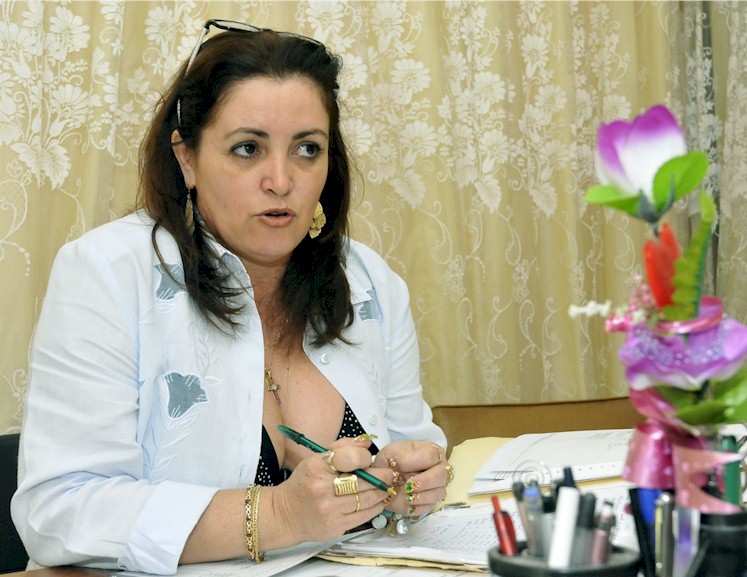
Nancy Varela
Medina, president of the cooperative, commented,
“Technically we were in a position to take on a
large volume of production.
Why not change and be in tune with the Cuban economy?”
There are currently 452 associations of this type
operating in the areas of commerce, restaurant
services, construction, transportation, food
processing and, recently added, energy and
accounting.
The
first cooperative noted by historians was created in
1884, when 28 English textile workers opened an
establishment in Rochdale, to ensure their community
access to food. The workers bought large quantities
of sugar, flour, salt and butter wholesale, and sold
the food to members, at prices lower than those of
other retail outlets, via an open membership
association characterized by democratic
decision-making; no political, racial or religious
discrimination; direct sales; distribution of
earnings; limited interest on capital; and
continuing education.
From
this point on, an expansion of the movement became
evident, leading to the 1895 formation in Europe of
the International Cooperative Alliance (ICA).
Estimates indicate that today at least 750,000
cooperatives exist around the world, with some 800
million members, more than 12% of the planet's
population. Data from the ICA show that cooperatives
currently offer services to one of every two people
internationally and that the 300 most important
associations are valued at more than two billion
dollars.
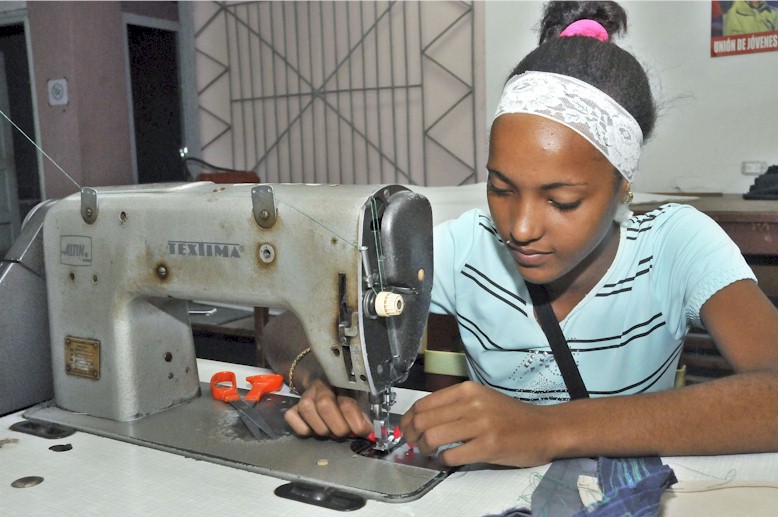
Naomi Karla Pez Lemus, a student at
Hermanos Armeijeiras Trade School,
is considering joining the cooperative after
graduation.
Cuba
has had experience with this form of workers'
association for more than 50 years, beginning with
the emergence in 1960 of Credit and Services
Cooperatives, after Agricultural Production
Cooperatives, followed in 1993 by the Basic Units of
Cooperative Agricultural Production - all in the
agricultural sector. This internationally recognized
contribution, has allowed the country to lead the
Latin American Cooperativism Network, an
organization which, along with the Federation of
Caribbean and Central American Cooperatives and
others, promote this mode of production across the
continent.
With
the expansion of coopertivism to other areas of the
economy, Cuba hopes to extend what has been learned
over the years into other sectors.
There is no doubt that the cooperative, as an
organizational alternative based on self-management,
is to play an important role in the updating of
Cuba's economic model. This was made evident in the
program approved at the Communist Party of Cuba's
6th Congress, which recognizes and promotes
cooperativism, along with the socialist state
enterprise, given the need to decentralize state
management and achieve greater efficiency.
Cooperatives clearly coincide with the country's
commitment to social justice, given their basic
principles of open, voluntary membership; democratic
control and participation; and commitment to the
community; in addition to their autonomy and
independence which allow for a work climate of
mutual support, responsibility, equality, equity and
solidarity.
Confecciones Model: A participative Cuban initiative
Since becoming a cooperative, the work environment
has been changing at Confecciones Model, previously
a state-run garment factory on San Rafael Street, in
Havana. About a year ago, workers at the shop,
devoted to the fabrication and sales of reasonably
priced clothes - principally the traditional Cuban
guayabera - foresaw the possibility of becoming
independent, separating themselves economically from
the state enterprise with which they had been
linked. Nancy Varela Medina, president of the
cooperative spoke with Granma International, saying,
“Technically we were in a position to take on a
large volume of production. Why not change and be in
tune with the Cuban economy?"
To
begin operating as a cooperative, the group had a
skilled workforce, good machinery, an adequate space
and central location. "We were the first to present
a project and it was really well-liked; it wasn't
easy, but we did it. We received approval from the
Council of Ministers and did the paperwork with the
international legal office, the commercial register,
and as of October 1, 2013, we began as a
cooperative."
Today there are 41 members, including stylists,
tailors, seamstresses, cutters and tracers - enough
to handle the large orders for uniforms and
guayaberas which the cooperative receives.
How
has work life changed?
Nancy Varela reports that the changes are palpable.
Previously workers received a fixed salary, plus
production bonuses; now salaries are based on sales.
"Being president of the Confecciones Model
Cooperative," she said, "is very different from
being the director of the garment shop." The pay
regimen now depends on earnings. Workers are paid in
accordance with what is earned from sales during the
previous month, taking into account their role, and
after fulfilling tax obligations; paying the
enterprise for use of the building and equipment;
and purchasing materials. “As an example,
seamstresses specialized in one job (making
guayaberas or custom suits) receive a salary which
is different from the others, and are paid according
to their skill category. It’s hard to find personnel
as well trained in tailoring as those who are here,
and we have to protect this."
For
80-year-old tailor Alfredo Valdés, beyond good
health, the two most important elements of his life
are music and sewing. "Music makes people happy and
without clothes, you can't look sharp. This is an
art. Tailors are engineers," Alfredo said, while
carefully cutting a custom suit jacket.
"There are very few tailors in Cuba. Young people
should be trained and shown the beauty of a
profession which must be recovered."
Despite some personal dissatisfaction, Alfredo feels
his life has improved since becoming a member of the
cooperative, saying, "Thus far, we're doing well,
but the cloth and thread must arrive without fail."
His
concern is well founded. According to Nancy Varela,
among the problems the new organization has faced is
irregular availability of basic supplies and their
cost. “We’ve faced some obstacles with supplies,”
she explained, “We sign contracts with the Universal
Habana entity to buy cloth and thread. We used to do
so via an intermediary. The biggest problem we’ve
had is with the price. Considering the volumes we
handle, we believe the price should be lower than
that offered self-employed individuals.”
Marquidia Pérez, who has worked at Confecciones
Model for almost 20 years, identified another
concern which could affect production. “Clients
leave here very satisfied with the quality of our
work, thanks, in large part, to the experience of
our tailors. But it is worrisome that they are quite
elderly and the next generation is meager. Young
people must be better trained and shown the value of
this work.”
The
new structure, she said, has been beneficial, both
economically and personally, “But what is most
fundamental,” she emphasized, “is that we are more
united and help each other a great deal. That is to
say, we work together. We know our survival depends
on our collective work, on the responsibility we
assume, and the decisions we make, to keep our
cooperative healthy.”
|


