Council of
Ministers discusses economic planning
Leticia Martínez
Hernández & Yaima Puig Meneses
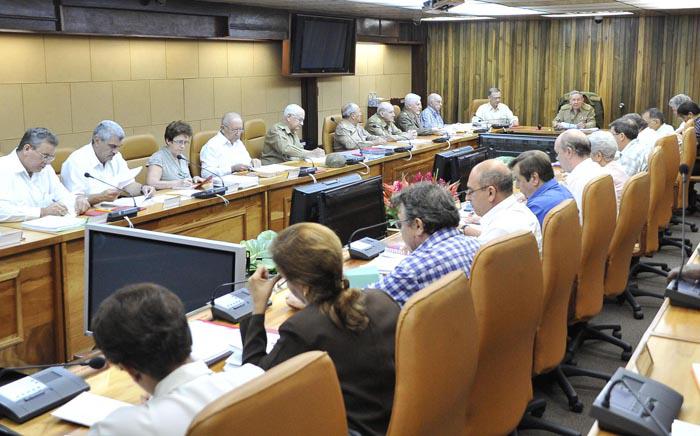
May 19, with President Raúl Castro
Ruz presiding, a Council of Ministers meeting was
held, during which Minister of Economy and Planning
Adel Yzquierdo Rodríguez explained mandates for the
development of the country’s 2015 Plan, which are
directed toward generating greater economic growth.
Yzquierdo, also a Council of
Ministers vice president, said that although the
preliminary estimates presented do not constitute
the Economic Plan, they are important to its
elaboration. Potential levels of performance in
various sectors of the economy, as well as social
services, were therefore discussed.
Important among the issues analyzed
were food production; the generation of electricity,
investment; commercial distribution - particularly
retail sales of construction materials; and
employment trends.
The Council of Ministers then
approved general guidelines for the preparation of
the 2016-2030 Socio-economic Development Program,
which were the result of a rigorous analysis
undertaken by all entities involved.
According to Marino Murillo Jorge,
head of the Implementation and Development Permanent
Commission and a Council of Ministers vice-president,
once the program is drafted, the country will have
"a vision of the future which reflects – via
concrete, measurable, long-term indicators – the
objectives, strategic direction, sources of
financing, goals and challenges to be overcome to
consolidate the construction of a prosperous,
sustainable, socialist society."
He indicated that among its basic
principles are "guaranteeing growth of the Gross
Domestic Product to ensure the development of well-being,
equity and social justice; maintaining social
ownership of the fundamental means of production;
achieving a socialist model of development, with
efficiency in all spheres; promoting science,
technology, innovation and their application;
transforming the energy profile with greater
emphasis on renewable resources; recovering and
modernizing the country’s infrastructure; and
assuring demographic sustainability.
Next, Leonardo Andollo Valdés,
deputy director of the Implementation and
Development Permanent Commission, presented
proposals for the improvement of the Ministries of
Transportation and Tourism, as part of the
reorganization which is underway in Central State
Administration bodies.
These proposals, he explained, are
directed toward achieving greater efficiency, and
separating government roles from those of
enterprises, while supporting the consolidation of
the state enterprise system reorganization. Also to
be strengthened is the autonomy of Central
Enterprise Management Organizations (OSDE).
He indicated that the two proposals,
now approved by the Council of Ministers, reflect
the conclusion of the first stage of improvement
planned for 20 Central State Administration bodies.
The process will continue as progress is made in
implementation of the Economic and Social Policy
Development Guidelines of the Party and the
Revolution.